They Thought They Were Free by Milton Mayer
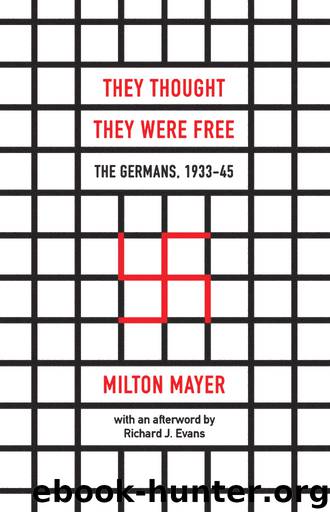
Author:Milton Mayer [Mayer, Milton]
Language: eng
Format: epub
Publisher: University of Chicago Press
CHAPTER 15
The Furies: Heinrich Hildebrandt
How was I to know, or to find out, how much my friends had suffered (if they had suffered at all) or whether they had suffered enough? If, as doctrine has it, man is perfected by suffering, none of my friends had suffered enough, for none of them, I could see, even in my imperfect knowledge of them, was perfect.
Seven of them ducked my question. My question, which I framed very carefully and put to them in a variety of ways in the last weeks of our conversations, was, “What did you do that was wrong, as you understand right and wrong, and what didn’t you do that was right?” The instinct that throws instant ramparts around the self-love of all of us came into immediate operation; my friends, in response, spoke of what was legal or illegal, or what was popular or unpopular, or what others did or didn’t do, or what was provoked or unprovoked. But I was interested, at this point, in none of these things. “Who knows the secret heart?” I was trying to know the secret heart; I knew all about Versailles and the Polish Corridor and the inflation, the unemployment, the Communists, the Jews, and the Talmud.
The eighth of my friends, young Rupprecht, the Hitler Youth leader, having taken upon himself (or having affected to take) sovereign responsibility for every first and last injustice of the whole Hitler regime, was no better able to enlighten me than Herr Schwenke, the old Fanatiker, who, when I was at last able to divert him, with my insistent last question, from Versailles, the Polish Corridor, etc., said, “I have never done anything wrong to any man.” “Never?” said I, just to hear myself say it. “Never,” said he, just to hear himself say it. But two of my friends, Herr Hildebrandt, the teacher, and Herr Kessler, the bank clerk, enlightened me, in their own time, in their own ways, without my having asked them my question.
Fear and advantage, Hildebrandt had said, were his reasons for becoming a National Socialist in 1937, a late “March violet” indeed. “Were there,” I said, on another occasion, “any other reasons you joined?” He said nothing and then began to blush. “I—,” he began, blushing fully, and then he said, “No, no others.” It was a long time before I learned all Herr Hildebrandt’s reasons for being a Nazi.
“I might have got by without joining,” he said more than once. “I don’t know. I might have taken my chances. Others did, I mean other teachers in the high school.”
“How many?”
“Let me see. We had thirty-five teachers. Only four, well, five, were fully convinced Nazis. But, of these five, one could be argued with openly, in the teachers’ conference room; and only one was a real fanatic, who might denounce a colleague to the authorities.”
“Did he?”
“There was never any evidence that he did, but we had to be careful around him.”
“How many of the thirty-five never joined the Party?”
“Five, but not all for the same reason.
Download
This site does not store any files on its server. We only index and link to content provided by other sites. Please contact the content providers to delete copyright contents if any and email us, we'll remove relevant links or contents immediately.
| Africa | Americas |
| Arctic & Antarctica | Asia |
| Australia & Oceania | Europe |
| Middle East | Russia |
| United States | World |
| Ancient Civilizations | Military |
| Historical Study & Educational Resources |
Room 212 by Kate Stewart(5119)
The Crown by Robert Lacey(4814)
Endurance: Shackleton's Incredible Voyage by Alfred Lansing(4780)
The Iron Duke by The Iron Duke(4354)
The Rape of Nanking by Iris Chang(4211)
Joan of Arc by Mary Gordon(4109)
Killing England by Bill O'Reilly(4001)
Say Nothing by Patrick Radden Keefe(3984)
I'll Give You the Sun by Jandy Nelson(3447)
Shadow of Night by Deborah Harkness(3367)
Hitler's Monsters by Eric Kurlander(3342)
Mary, Queen of Scots, and the Murder of Lord Darnley by Alison Weir(3210)
Blood and Sand by Alex Von Tunzelmann(3203)
Eleanor & Park by Rainbow Rowell(3172)
Darkest Hour by Anthony McCarten(3129)
Margaret Thatcher: The Autobiography by Thatcher Margaret(3082)
Book of Life by Deborah Harkness(2938)
Red Famine: Stalin's War on Ukraine by Anne Applebaum(2933)
The One Memory of Flora Banks by Emily Barr(2863)
